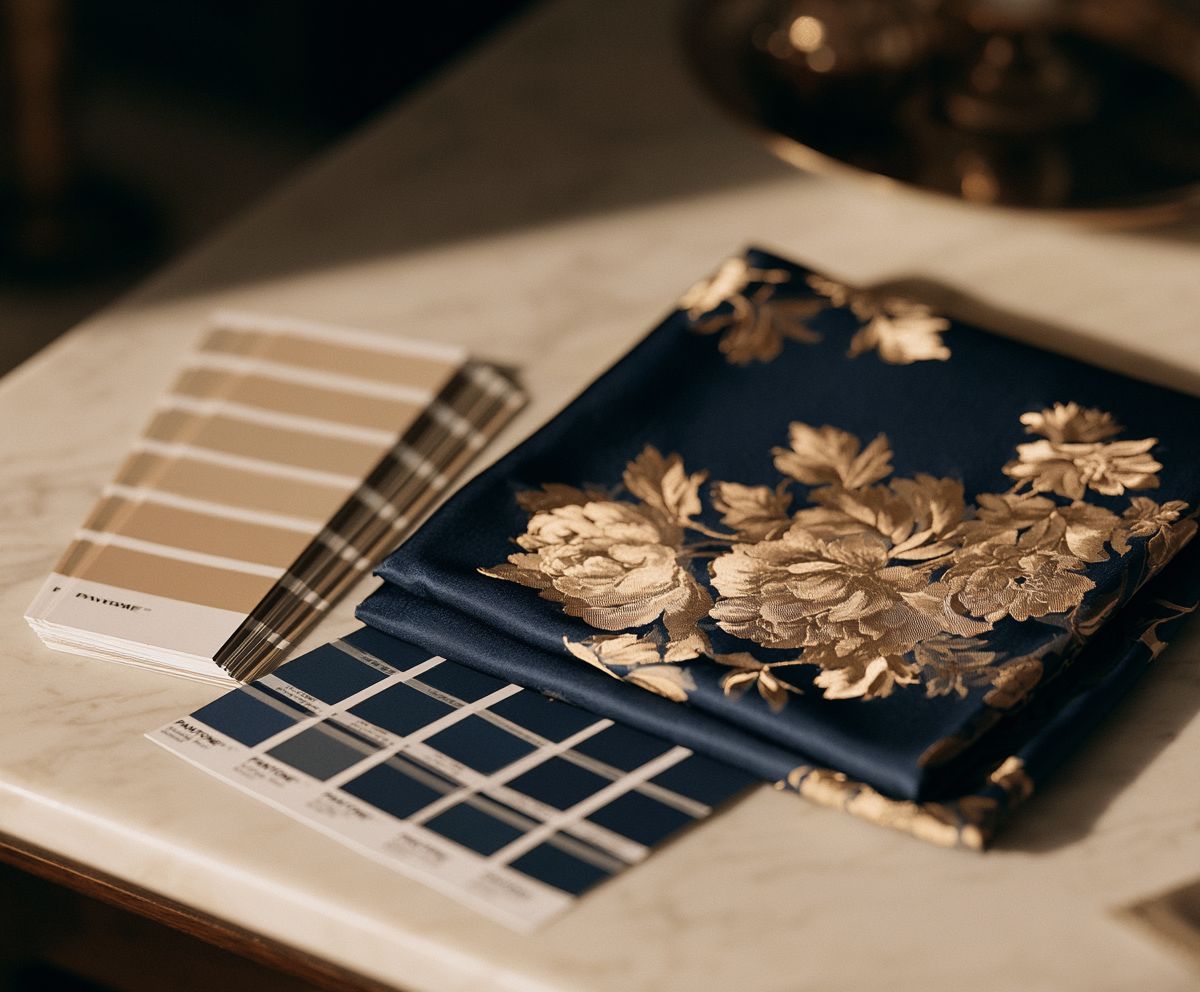
Pantone Color Matching on Silk: How Brands Get Their Colors Exactly Right
The corporate blue that is not quite the corporate blue: every brand manager's nightmare. Here is how professional color matching on silk actually works — and how to ensure your brand colors arrive on fabric exactly as designed.
Every brand manager knows the moment: the printed sample arrives, and the corporate blue is not quite the corporate blue. In most industries this is an annoyance. In brand accessories — where the product exists specifically to carry the brand — it is a project failure.
This article explains how professional color matching on silk actually works, what Pantone references can and cannot guarantee, and how to ensure your brand colors arrive on fabric exactly as they should.
Why Color on Fabric Is Different From Color on Screen
Your brand guidelines define colors for screens (RGB/HEX) and print on paper (CMYK, Pantone). Fabric is a third world entirely. Silk absorbs and reflects light differently from paper; the weave structure — twill's diagonal texture, satin's sheen — changes how a color reads; and digital textile inks have their own gamut, distinct from offset printing.
The practical consequence: the same Pantone reference will look subtly different on paper, on silk twill and on silk satin. Professional production does not eliminate this reality — it manages it with expertise.
What Pantone Matching Actually Means in Textile Production
When a manufacturer offers Pantone color matching, the process works like this:
1. Reference intake. You provide Pantone codes (ideally from the Pantone TCX textile system, though standard coated references work as a starting point).
2. Color profiling. The printer translates each reference into its digital printing system, calibrated for the specific fabric — because the same ink recipe renders differently on twill versus satin versus crepe.
3. Printed color proofing. Test prints on the actual production fabric verify each critical color. This is where decades of Como printing expertise show: knowing in advance how a saturated red or a pale corporate grey will behave on silk.
4. Physical sample approval. You judge the colors on the real fabric, in real light — never on a screen. Only after this approval does bulk production begin.
The Colors That Deserve Special Attention
Experience teaches that certain colors need extra care on silk:
Corporate navy and dark blues — the most common brand colors, and among the trickiest: small shifts read immediately as "wrong." Always verify on a printed swatch.
Greys and neutrals — they pick up warm or cool casts from fabric and light. A grey approved on screen can look beige or bluish on silk.
Very saturated brights — digital textile printing has an excellent gamut, but the most extreme neon-adjacent tones may need managed expectations or creative adaptation.
Metallic golds and silvers — true metallics do not exist in standard digital printing; skilled designers achieve the effect through tonal illustration.
Practical Guidance for Brand Teams
Send Pantone codes, not just a logo file. A JPG's colors depend on the screen displaying it. Codes are unambiguous.
Identify the one critical color. Most brands have a single non-negotiable color and several flexible ones. Telling your manufacturer which is which focuses precision where it matters.
Judge samples in daylight. Colors shift under office LED lighting. Evaluate the physical sample near a window, in neutral daylight, ideally against your printed brand materials.
Approve in writing. The approved physical sample becomes the binding color reference for bulk production — protecting both sides.
Why This Is a Como Specialty
Color fidelity on silk is not a software feature — it is accumulated knowledge. The Como district has spent generations mastering how dyes and inks behave on every silk weave, in every finishing process. That expertise is precisely what a brand buys when it produces in Como: the confidence that the blue on the scarf is the blue in the guidelines.
Your brand spent years building its colors. Production should honor them to the thread.
Seraya Studios offers Pantone color matching on all custom silk production — verified on printed samples before every bulk run, entirely in Como, Italy. Discuss your project at info@serayastudios.com
Ready to Create Something Extraordinary?
Contact us for a free custom production quote. Made in Como, Italy.
Request a Quote