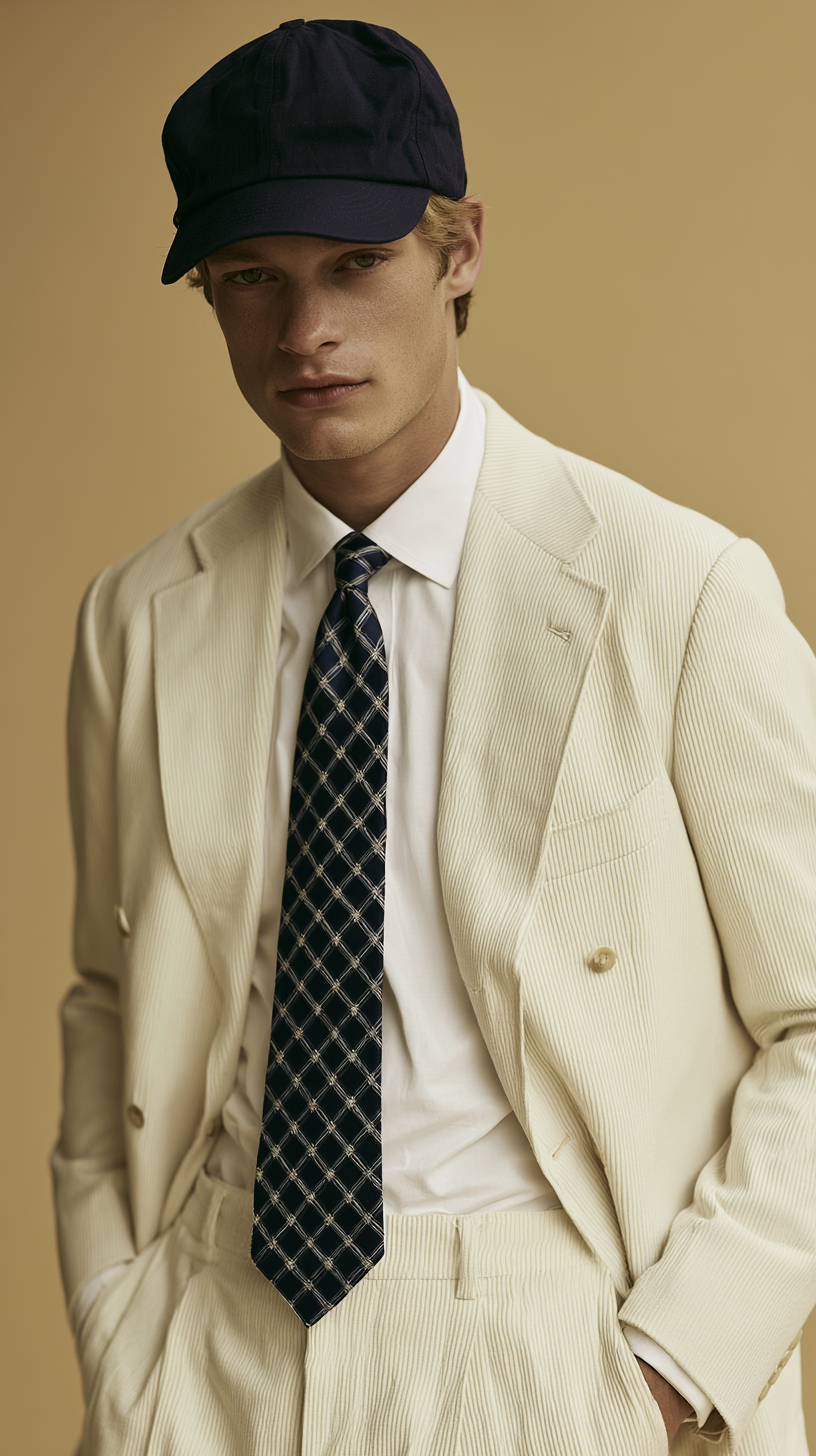
Custom Printed Silk Ties: The Definitive Guide for Companies and Organizations
The custom silk tie remains one of the most powerful identity accessories an organization can commission — worn by teams, gifted to members, treasured by recipients. This definitive guide covers design, fabrics, production and why Italian construction makes the difference.
Few accessories carry institutional identity like the tie. From universities and private clubs to corporations and sports federations, the custom tie has represented belonging, achievement and affiliation for over a century.
Today, digital printing on silk has transformed what is possible — making fully custom tie design accessible at reasonable quantities, with a precision that traditional weaving could never achieve. This guide covers everything organizations need to know about commissioning custom printed silk ties.
The Enduring Power of the Custom Tie
In an era of casual dress codes, one might expect the tie to fade. The opposite has happened in the world of custom accessories: precisely because the tie is no longer mandatory, wearing one has become a deliberate statement — and a custom tie a deliberate statement of identity.
Institutional Identity
Organizations use custom ties to make membership visible: companies for their teams and events, clubs for their members, federations for their delegations, schools and universities for their communities. A well-designed tie transforms a group of individuals into a recognizable body.
The Gift of Belonging
Unlike a generic gift, a custom tie can only be given — it cannot be bought. This exclusivity is its power. Receiving the tie means being part of something, and recipients understand this instinctively.
Ceremonial Weight
Anniversaries, inaugurations, championship celebrations, retirement honors — the custom tie marks occasions with a formality that few other objects achieve. Many recipients keep ceremonial ties for decades.
Printed vs Woven: Understanding the Difference
Traditional custom ties were woven — the design created by the interlacing of colored threads on a jacquard loom. Printed ties, by contrast, begin with a plain silk fabric onto which the design is printed digitally.
Woven ties excel at classic, repeating patterns — stripes, small motifs, club patterns — and offer a distinctive textured surface. They require significant minimums and longer development.
Printed ties excel at everything weaving cannot do: photographic detail, gradients, unlimited colors, complex illustrations, precise logo reproduction. Digital printing also allows lower minimums and faster production — which is why printed silk ties have become the standard choice for corporate and event projects.
For most organizations commissioning custom ties today, printing is the practical and creative winner.
Design Principles for Custom Ties
Designing for a tie is unlike designing for any other accessory. The visible surface is narrow, long and worn vertically — with the most important zone being the lower front blade.
The Repeat Pattern Approach
The most traditional structure: a small motif — logo, emblem, initial — repeated diagonally across the tie. Understated, institutional, timeless. The scale of the repeat determines the personality: micro-repeats read as classic, larger repeats as contemporary.
The Placement Design Approach
Digital printing allows placing specific elements at exact positions — an emblem precisely on the lower blade, a subtle detail near the tip, a message on the underside of the tail visible only to the wearer. This last option is a favorite for commemorative ties: a date, a motto or a signature hidden inside.
The All-Over Contemporary Approach
For events, fashion contexts and younger organizations, the tie can carry a full artistic composition — an illustrated scene, an abstract gradient, an architectural motif. These pieces function as wearable art and photograph beautifully.
Color Strategy
The tie must work against shirts and jackets. Designs anchored in navy, burgundy, forest green and charcoal have the widest wearability; brand colors can be integrated as accents rather than dominant fields when the corporate palette is unconventional.
Construction and Quality Details
A tie is a constructed object — far more complex than a flat accessory. Quality reveals itself in specific details:
The silk. Printed ties typically use silk twill, whose diagonal weave gives the tie its characteristic surface and resilience.
The interlining. Inside every tie is an interlining that gives it body, weight and recovery. Quality interlining means the tie knots beautifully and returns to shape after wearing.
The slip stitch. A hand-sewn slip stitch running inside the tie allows it to flex and recover. It is the mark of proper construction.
The bar tack and keeper loop. Small details — the reinforcement stitch and the loop holding the tail — that separate a finished tie from a cheap one.
At Seraya Studios, tie production follows the construction standards of the Italian tradition — because a beautifully printed tie with poor construction is a wasted opportunity.
Who Commissions Custom Printed Ties
Companies — for sales teams, annual conventions, executive gifts and milestone celebrations.
Banks and financial institutions — for client gifts and staff identity, where the tie's formality matches the industry's culture.
Sports clubs and federations — for official delegations, championship commemorations and member editions.
Universities, schools and alumni associations — the classic territory of the institutional tie, renewed by printing possibilities.
Weddings and private events — coordinated ties for groomsmen, designed around the celebration.
Luxury hotels and hospitality groups — as staff uniform elements that elevate the guest-facing image.
The Production Process, Step by Step
1. Brief and design development. You share your brand assets, concept or inspiration; the design team develops the tie artwork, presented as a realistic visualization.
2. E-proof approval. A digital proof shows the exact design, dimensions and colors. Nothing proceeds without your approval.
3. Physical sampling. A real tie is produced for your evaluation — the moment to verify silk quality, print fidelity, construction and knotting behavior.
4. Bulk production. Upon sample approval, full production begins — printing, cutting, interlining, sewing and finishing, entirely within the Como district.
5. Delivery. Ties are individually packaged and shipped worldwide.
From sample approval, bulk production typically requires 4 to 6 weeks depending on volume — a timeline organizations should build into their event and gifting calendars.
Why Italy — and Why Como
The tie is arguably the most Italian of all accessories. The world's finest ties have been produced in Italy for generations, and the Como district — with its unmatched concentration of silk printing and finishing expertise — sits at the center of this tradition.
For an organization, choosing Italian production is not sentimentality. It is quality assurance. The fabric, the print, the construction and the finishing all draw on a supply chain refined over centuries. And the label — Made in Italy — adds a layer of prestige that recipients recognize instantly, anywhere in the world.
A custom tie will represent your organization on chests and in photographs for years. There is exactly one production tradition worthy of that role.
Seraya Studios produces custom printed silk ties for companies, institutions and events — entirely made in Como, Italy. Write to info@serayastudios.com to start your project.
Ready to Create Something Extraordinary?
Contact us for a free custom production quote. Made in Como, Italy.
Request a Quote