The Silk Scarf: A Brief History of the World's Most Versatile Accessory
- serayastudios
- May 7
- 5 min read

Few accessories have traveled as far, across as many cultures and centuries, as the silk scarf. From the battlefields of ancient China to the runways of Paris, from the necks of royalty to the wrists of fashion editors, the silk scarf has reinvented itself repeatedly — without ever losing its essential character.
This is the story of how a simple rectangle of fabric became one of the most enduring objects in the history of dress.
The Origins: China and the Ancient World
Silk itself was born in China, where legend places its discovery around 2700 BC — attributed, with characteristic elegance, to the Empress Leizu, who is said to have watched a silkworm cocoon unravel into a single continuous thread while sitting beneath a mulberry tree.

For centuries, silk production remained a closely guarded Chinese secret, protected by imperial decree. The fabric was so precious that it was used as currency, as diplomatic gift and as a marker of social status. The earliest silk scarves — long, narrow bands of fabric worn around the neck or head — appear in Chinese records as early as the Qin dynasty, around 200 BC, where they were used to distinguish the ranks of soldiers and officials.
The Romans called it serica — the fabric from the East — and paid extraordinary sums to import it along the Silk Road. A single pound of silk was worth a pound of gold.
The Middle Ages and the Renaissance: Silk Comes to Europe
As trade routes expanded and the secrets of silk production gradually spread westward, European weavers began to develop their own traditions. By the 13th and 14th centuries, Italian city-states — Venice, Florence, Genoa — had established themselves as the centers of European silk production.

Como entered the picture in the 15th century, when the cultivation of mulberry trees and the breeding of silkworms became established along the shores of Lake Como. The district's cool climate, clean water and centuries of accumulated weaving expertise created the conditions for what would become the world's most sophisticated silk textile industry.
By the Renaissance, silk scarves and neck cloths had become standard elements of aristocratic dress across Europe — worn by men and women alike as symbols of refinement and wealth.
The 17th and 18th Centuries: The Cravat and the Birth of the Necktie
The modern history of the silk scarf as a fashion accessory begins, somewhat unexpectedly, on a battlefield.
During the Thirty Years War in the 1630s, Croatian mercenaries fighting for the French army wore distinctive knotted neckerchiefs as part of their uniform. The French, with their characteristic eye for style, were captivated. King Louis XIV adopted the fashion, called the accessory a cravate — a corruption of Croate, meaning Croatian — and transformed it into a mandatory element of aristocratic dress at the court of Versailles.
The cravat became the ancestor of both the modern necktie and the folded silk pocket square — two accessories that still carry its DNA today.
The 19th Century: Industrialisation and the Rise of the Printed Scarf
The industrial revolution transformed silk production. Mechanical looms — most notably the Jacquard loom, invented in Lyon in 1804 — made it possible to weave complex patterns at scale for the first time. Printed silk became more accessible, and the silk scarf began its transition from purely aristocratic object to aspirational fashion accessory.

In England, the paisley shawl — produced in the Scottish town of Paisley in imitation of expensive Indian cashmere shawls — became a mass fashion phenomenon in the mid-19th century. The paisley motif, originally derived from Persian and Indian textile traditions, entered the visual vocabulary of Western fashion where it remains to this day.
In France, the luxury houses of Paris began commissioning printed silk scarves as fashion objects in their own right — setting the stage for what was to come in the 20th century.
The 20th Century: Icons, Runways and a New Language
The 20th century is where the silk scarf truly became a cultural icon.

In 1937, a Parisian luxury house launched its first printed silk scarf — a square of twill silk that would go on to become one of the most recognizable objects in the history of fashion. The printed square scarf, carried over the arm or tied at the neck, became the defining accessory of mid-century elegance.
In the 1950s and 1960s, the silk scarf reached its cultural peak. Grace Kelly used one to support an injured arm in a photograph that defined an era. Audrey Hepburn tied one around her hair in Roman Holiday. Jackie Kennedy wore them on her head, around her neck and as belts. The silk scarf was everywhere — and it meant something. It communicated refinement, worldliness and a particular kind of effortless style.
In the 1970s and 1980s, the scarf evolved again — worn loosely, tied to bags, used as a bandana or wrapped around the wrist. Each decade found a new way to wear it without diminishing its essential elegance.
The 21st Century: Custom, Sustainable and More Relevant Than Ever
Today the silk scarf occupies a unique position in the world of accessories. It is simultaneously a heritage object — carrying five centuries of European craft tradition — and a contemporary tool for brand expression.
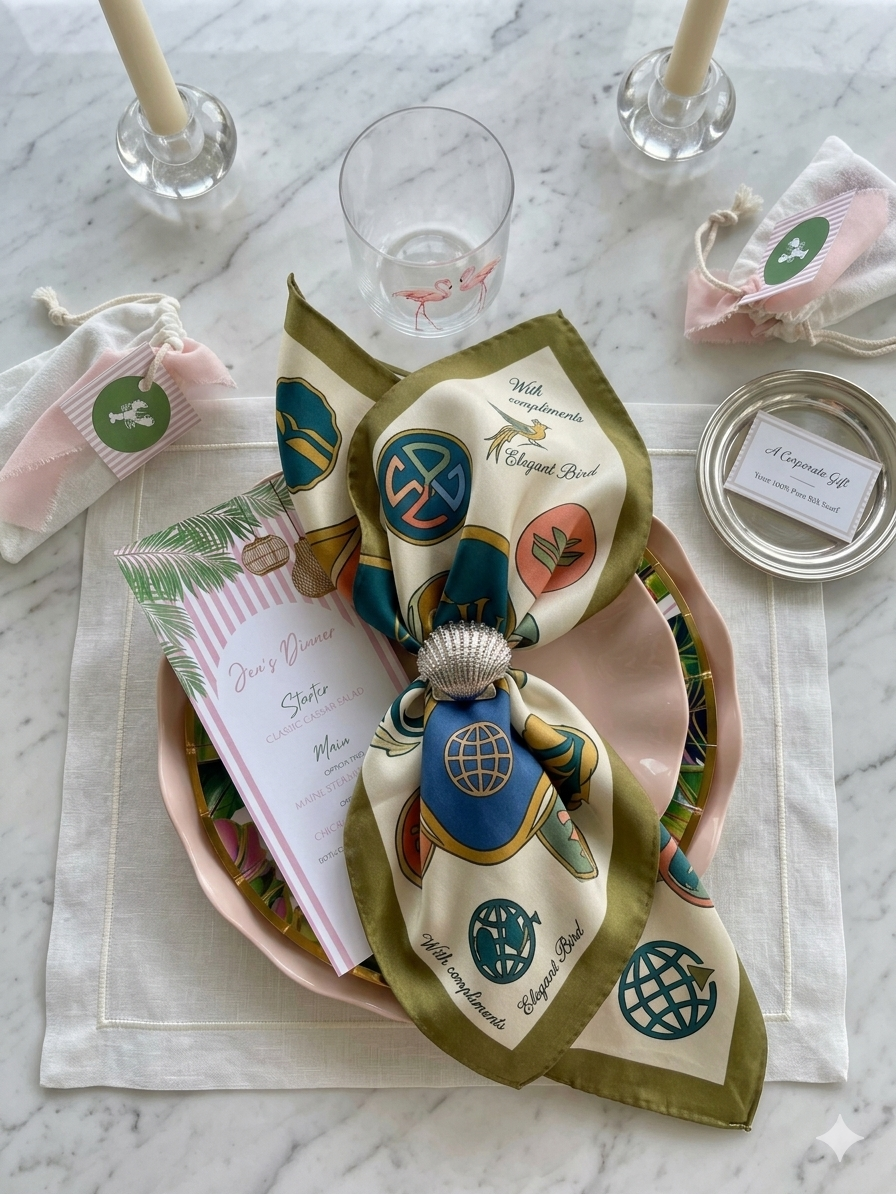
Fashion brands use printed silk scarves to communicate their visual identity in a format that is wearable, collectible and highly visible. Hotels commission custom silk accessories to offer guests a tangible, luxurious connection to their brand. Companies choose silk scarves as corporate gifts because they communicate quality, thoughtfulness and attention to detail in a way that nothing else does.
The rise of sustainable fashion has also brought new attention to silk as a material. As a natural fiber produced from silkworm cocoons, silk is biodegradable and renewable — a meaningful alternative to synthetic fabrics in a world increasingly aware of the environmental cost of fast fashion.
And the craft tradition that makes it all possible — the printing, the finishing, the hand-rolled hems — remains alive and thriving in one place above all others: Como, Italy.
Como: Where the Story Continues
For over five centuries, the shores of Lake Como have been at the center of the world's silk story. The district's weavers, printers and finishers have dressed kings and movie stars, supplied the world's greatest fashion houses and produced some of the finest textile accessories ever made.

At Seraya Studios, we are part of this tradition. Every foulard, twilly, pocket square, stole and pareo we produce is made here — in the district that has defined silk craftsmanship for five hundred years.
The silk scarf has survived empires, revolutions and the rise and fall of countless fashion trends. It will outlast the next ones too.
Want to add the silk scarf to your brand's story? Contact us


Comments